
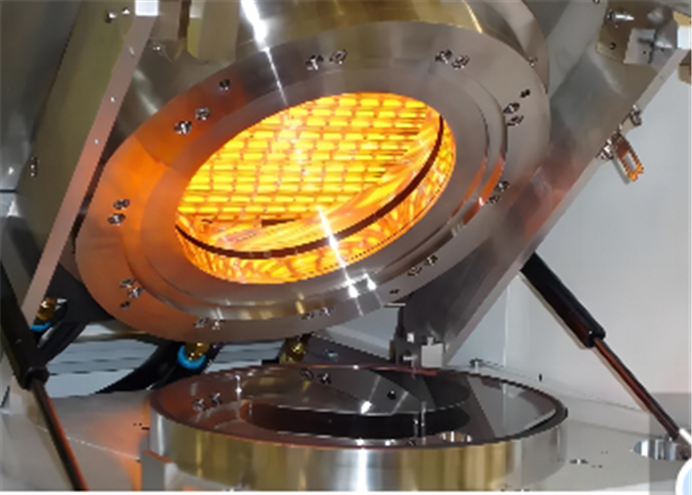
Out on the line, OLED lithography doesn’t give you any room for thermal drift. Soft bake that drifts even ±0.5°C off target and you’ll see CD uniformity tilt, plus resist profiles that fight the etch. You need a drying lamp that holds like a fixed point, not something that wanders with the day. What we built, and why We put the OLED drying lamp on short-wave infrared (SWIR) halogen emitters inside a quartz envelope. That gives fast, direct energy transfer into the photoresist with minimal heating of the substrate underneath. The heater array is mapped so the bake zone stays within ±0.1°C across the wafer, and repeatability holds at 0.05°C cycle-to-cycle. The system is rated for Class 1–100 cleanrooms, and we’ve verified zero particle generation with in-situ monitoring. Control is closed-loop, using a calibrated pyrometer and emissivity compensation to measure temperature at the resist surface, not at the lamp housing. Why it behaves in OLED fabs In OLED drying and photoresist bake steps, the thermal budget is tight. Too cool and the solvents don’t clear. Too hot and outgassing creates defects that carry right into patterning. This lamp lands the resist bake temperature precisely, every cycle, so CD control and sidewall angle stay stable across the lot. The fast ramp shortens the bake window, which boosts throughput without pushing peak temperatures. It’s efficient by design: high electrical-to-radiant conversion and low thermal mass mean lower utility spend and less waste heat bleeding into the cleanroom. Reliability is built for 24/7, with field data showing thousands of hours at stable output. What you need to plan for The lamp is compact, but it needs a dedicated exhaust path and a clean electrical feed to keep performance stable. If you’re integrating into legacy tracks, expect to deal with a mechanical and control interface adapter. Confirm the connector, mounting envelope, and PLC interlocks before cutover. Run a short commissioning sequence to finalize the bake profile against your resist stack—then lock it in.